The Nature of the Mind by Jiddu Krishnamurti
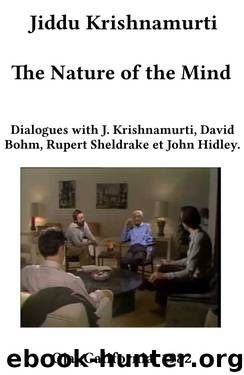
Author:Jiddu Krishnamurti [Krishnamurti, Jiddu]
Language: eng
Format: epub
Published: 0101-01-01T00:00:00+00:00
The Need for Security
TOM KRAUSE: This is one of a series of dialogues between J Krishnamurti, David Bohm, Rupert Sheldrake and John Hidley. The purpose of these discussions is to explore essential questions about the mind. What is psychological disorder, and what is required for fundamental psychological change? J Krishnamurti is a religious philosopher, author and educator who has written and given lectures on these subjects for many years. He has founded elementary and secondary schools in the United States, England and India.
David Bohm is professor of theoretical physics at Birkbeck College, London University in England. He has written numerous books concerning theoretical physics and the nature of consciousness. Professor Bohm and Mr Krishnamurti have held previous dialogues on many subjects.
Rupert Sheldrake is a biologist whose recently published book proposes that learning in some members of a species affects the species as a whole. Dr Sheldrake is presently consulting plant physiologist to the International Crops Research Institute at Hyderabad, India.
John Hidley is a psychiatrist in private practice who has been associated with the Krishnamurti school at Ojai, California for the past six years.
In the first two dialogues consideration has been given to the process of self identification. A range of subjects has been related to this process, including the problem of suffering, the role of thinking and memory, images, and the uniqueness or commonality of consciousness. Can these processes be observed, and what is the relationship of observation to order, responsibility and change? Today's discussion focuses on the question: is there such a thing as absolute psychological security?
Hidley: We would like to talk about the question of whether there is a deep security, whether the self can be dissolved. You have suggested that if that's possible, then the problems that the individual brings to the office, the problems...
Krishnamurti: Sir, why do we seek security, apart from physical? Apart from terrestrial security, why do we want security?
Hidley: Well, we know moments of peace and happiness, and we want to stabilize that, hold that.
Krishnamurti: Then that becomes a memory.
Hidley: Yes.
Krishnamurti: Not actual security. A memory that one day we were happy, and I wish we could go back to it. Or you project an idea and a hope someday to achieve it. But why is it that human beings, probably throughout the world, seek security? What is the raison d'etre, I mean, what is the demand for security? What makes people ask for security, psychologically?
Hidley: Well, they're occupied, they're filled with their problems. There's the feeling that if I can solve the problem, if I can find out what the right answer is, if...
Krishnamurti: That's not security, surely. There is great uncertainty, great sense of emptiness in oneself, loneliness. Really, loneliness - let's take that for an example.
Hidley: Okay.
Krishnamurti: I may be married, I may have children and all the rest of it but I still feel isolated, lonely. And it's frightening, depressing, and I realize it is isolating. After all, loneliness is the essence of isolation, in which I have no relationship with anybody.
Download
This site does not store any files on its server. We only index and link to content provided by other sites. Please contact the content providers to delete copyright contents if any and email us, we'll remove relevant links or contents immediately.
Unwinding Anxiety by Judson Brewer(73199)
The Art of Coaching by Elena Aguilar(53422)
The Fast Metabolism Diet Cookbook by Haylie Pomroy(21182)
Rewire Your Anxious Brain by Catherine M. Pittman(18712)
Healthy Aging For Dummies by Brent Agin & Sharon Perkins RN(17071)
Talking to Strangers by Malcolm Gladwell(13443)
The Art of Thinking Clearly by Rolf Dobelli(10602)
Mindhunter: Inside the FBI's Elite Serial Crime Unit by John E. Douglas & Mark Olshaker(9421)
Crazy Rich Asians by Kevin Kwan(9348)
The Compound Effect by Darren Hardy(9057)
Tools of Titans by Timothy Ferriss(8494)
Periodization Training for Sports by Tudor Bompa(8332)
Becoming Supernatural by Dr. Joe Dispenza(8278)
Wonder by R. J. Palacio(8170)
Bodyweight Strength Training by Jay Cardiello(7969)
Crystal Healing for Women by Mariah K. Lyons(7967)
Change Your Questions, Change Your Life by Marilee Adams(7848)
Nudge - Improving Decisions about Health, Wealth, and Happiness by Thaler Sunstein(7759)
Therapeutic Modalities for Musculoskeletal Injuries, 4E by Craig R. Denegar & Ethan Saliba & Susan Saliba(7746)
